Code
library(photobiology)
library(photobiologyFilters)
library(photobiologyWavebands)
library(ggspectra)
library(patchwork)
library(knitr)

theme_set(theme_bw() + theme(legend.position = "top")) filters, ultraviolet, spectra
In this page code chunks can be “folded” so as to decrease the clutter. Above each plot, table or other R-code output you may find one or more “folded” code chunks signalled by a small triangle followed by “Code”. Clicking on the triangle “unfolds” folded chunks making the R code that produced the printed values, plots or tables visible. Clicking on the same icon on an “unfolded” chunk, folds it hiding the code.
The code when visible in the chunks can be copied by clicking on the top right corner, where an icon appears when the mouse cursor hovers over the code listing.
The </> Code drop down menu to the right of the page title makes it possible to unfold and fold all code chunks in the page and to view the Quarto source of the whole web page.
library(photobiology)
library(photobiologyFilters)
library(photobiologyWavebands)
library(ggspectra)
library(patchwork)
library(knitr)
theme_set(theme_bw() + theme(legend.position = "top")) knitr::opts_chunk$set(
fig.width = 7, fig.height = 4, dev = "svg", out.width = "95%", warning = FALSE, message = FALSE
)Filters can block radiation by absorption or by reflection. Most common absorptive filters are made of special glass coloured with different inorganic ions. Plastic filters are made of acrylic or polycarbonate either tinted or coated on the surface. Finally, filters can be made as thin films, originally of coloured gelatin, and used as is, or encased between two thin sheets of clear glass (an approach rarely used today).
This page focuses on optical transmitting in the UV region and blocking VIS light. Most of UV-pass absorptive-glass filters transmit significantly in the NIR region, and need to be combined with additional filters to block NIR. One approach is the use of stack of filters with different spectral transmittance.
Commercial UV-pass filters used in astrophotography usually combine an absorptive (or clear) glass substrate with an interference (reflective) filter deposited on one or both of its surfaces. Some filters can even combine a stack of two absorptive glasses with an interference filter deposited on the outer surface.
Purely reflective UV-band-pass filters are also available. They are udsually very expensive and their spectral transmittance depends on the angle of incidence of light, i.e., the wavelength boundaries of the transmission band shift.
I have been buying special filters from Tangsinuo through AliExpress or eBay for some years now. Chinese glass is cheaper than that from the best known brands Hoya (Japan) and Schott (Germany), specially when bought as ready-assembled filters for photography from Heliopan or specialized suppliers. Hoya and Schott glass are the “gold standard”. Chinese glass filters on the other hand have a reputation of having inconsistent quality. So while much cheaper, they tend to be seen as cheap and low quality substitutes for Hoya and Schott glass. There are two types of quality problems: 1) the out-of-specifications transmission spectra and 2) striations, bubbles and other optical defects. In most cases, the later problems are irrelevant when filters are used on light sources but important when used on a camera lens. Off-specification spectral characteristics are important in both cases, and can affect both cut-off or cut-in wavelengths and how well off-band wavelengths are blocked.
In general Chinese glass is described as more variable, with specifications that seem to have more relaxed tolerances for a given type. For example, the infrared long-pass filters from Zomei can have cut-in wavelengths significantly different to those expected from their type, and can vary among filters having the same type description. Whether this is important depends on how the filters are used. If one has a single filter, a difference of a few tens of nanometres in the infrared will be difficult to notice in the resulting image without a side by side comparison, but if one would like consistent results with equivalent filters of different sizes or if ones aims are not just pictorial but scientific illustrations, such differences can matter. Poor blocking of off-band wavelengths can be a major problem in UV photography.
That Chinese glass is more variable means that a seller that selects and sells good melts of glass will sell much better goods than one who does no selection or even may sell the rejects. The difficulty is that good quality and poor quality or out-of-specifications glass melts are all sold using the same codes to identify them. Frequently, in AliExpress and eBay filters are described using codes for Schott glass. However, such glasses cant differ significantly from the corresponding Schott glasses. In other words, one needs to trust that the seller sells filters that are close enough to the description provided. If one lacks a spectrometer to measure the transmission of the filters that one buys, one cannot be sure that the filter that has been delivered agrees with the description.
I am able to measure the spectral transmittance of the filters I buy as well as their thickness. The typical spectral transmittance for Schott and Hoya glass are available as part of the specifications provided by the manufacturers. So, as I have measured the spectral transmittance of filters bought from Tangsinuo, I can compare these measured spectra to the specifications of Schott glass they are advertised or described to be equivalent to.
Some types of filters I have bought in two or three sizes from Tangsinuo, and comparing them can give some rough idea of how much variability there in the spectral transmittance of filters from a given supplier. It is however, important to keep in mind, that there is variation from melt to melt also for Hoya and Schott glass and that the spectra published by Schott are described as typical and subject to variation.
I have measured total spectral transmittance, that is including the effect of reflection. Most of the filters I have are 2 mm-thick. The specifications from Schott are for internal transmittance plus a reflection factor, and not always for a thickness of 2 mm. As a first step we need to compute the total transmittance for a thickness of 2 mm. Figure 1 shows the resulting spectra that we will use as reference.
Schott_UG.mspct <-
  filters.mspct[c("Schott_UG1", "Schott_UG11", "Schott_UG5", "Schott_BG3")]
Schott_UG.mspct <-
  convertThickness(Schott_UG.mspct, thickness = 2e-3)
Schott_UG.mspct <-
  convertTfrType(Schott_UG.mspct, Tfr.type = "total")
Schott_UG.mspct <-
  trim_wl(Schott_UG.mspct, range = c(200, NA), fill = 0)
Schott_UG.mspct <-
  trim_wl(Schott_UG.mspct, range = c(NA, 1050), fill = NULL)

autoplot(Schott_UG.mspct, annotations = c("-", "peaks"),
         w.band = c(UV_bands("CIE"), IR_bands("CIE"))) +
  labs(linetype = "")
We then compare the specifications to actual Schott glass of the same type (Figure 2). The agreement is not perfect. This is expected, as the specifications are for a typical glass melt and subject to variation.
autoplot(c(Schott_UG.mspct["Schott_UG1"],
           filters.mspct["UQG_UG1_2mm"]),
         annotations = list(c("+", "boundaries"), c("-", "peaks")),
         pc.out = TRUE) +
  labs(linetype = "")

autoplot(normalize(c(Schott_UG.mspct["Schott_UG1"],
           filters.mspct["UQG_UG1_2mm"])),
         annotations = list(c("+", "boundaries"), c("-", "peaks"))) +
  labs(linetype = "")

Next a comparison between Schott UG1 and generic ZWB2 at the same thickness of 2 mm (Figure 3). Transmittance of the ZWB2 is higher both in the UV region and in the NIR region. Normalization shows that the shape of the spectrum is very similar to the measured UG1 but a little less dense at the same thickness.
autoplot(c(Schott_UG.mspct["Schott_UG1"],
           filters.mspct[c("Tangsinuo_ZWB2_2.0mm_52mm",
                         "Tangsinuo_ZWB2b_2.0mm_52mm")]),
         annotations = list(c("+", "boundaries"), c("-", "peaks")),
         pc.out = TRUE) +
  labs(linetype = "")

autoplot(normalize(c(Schott_UG.mspct["Schott_UG1"],
           filters.mspct[c("Tangsinuo_ZWB2_2.0mm_52mm",
                         "Tangsinuo_ZWB2b_2.0mm_52mm")])),
         annotations = list(c("+", "boundaries"), c("-", "peaks"))) +
  labs(linetype = "")

Next a comparison between Schott UG11 specifications and generic ZWB1 (Figure 4) at the same thickness of 2 mm, gives a good match although the ZWB1 transmits slightly more in the NIR. Transmittance of the ZWB1 is higher both in the UV region and in the NIR region. Normalization shows that the shape of the spectrum is very similar to the measured UG11 with slightly higher transmittance in the NIR. Overall a little less dense at the same thickness. The second ZWB1 was sold very cheaply and not advertised as for use in photography, it is thinner at 1.6 mm and also has a few optical imperfections. This second ZWB1 filter transmits almost twice as much in the NIR as the UG11 or the ZWB1 sold for use in photography.
autoplot(c(Schott_UG.mspct["Schott_UG11"],
           filters.mspct[c("Tangsinuo_ZWB1_1.6mm_67mm",
                         "Tangsinuo_ZWB1_2.1mm_52mm")]),
         annotations = list(c("+", "boundaries"), c("-", "peaks")),
         pc.out = TRUE) +
  labs(linetype = "")

autoplot(normalize(c(Schott_UG.mspct["Schott_UG11"],
                     filters.mspct[c("Tangsinuo_ZWB1_1.6mm_67mm",
                                     "Tangsinuo_ZWB1_2.1mm_52mm")])),
         annotations = list(c("+", "boundaries"), c("-", "peaks"))) +
  labs(linetype = "")

The Schott UG5 filter has relative high transmittance in the NIR region (Figure 5). The ZWB3 filter it is usually described as a UV+NIR pass filter, or a VIS-blocking absorptive filter.
autoplot(c(Schott_UG.mspct["Schott_UG5"],
                     filters.mspct["Tangsinuo_ZWB3_2.2mm_52mm"]),
         annotations = list(c("+", "boundaries"), c("-", "peaks")),
         pc.out = TRUE) +
  labs(linetype = "")

autoplot(normalize(c(Schott_UG.mspct["Schott_UG5"],
                     filters.mspct["Tangsinuo_ZWB3_2.2mm_52mm"])),
         annotations = list(c("+", "boundaries"), c("-", "peaks")),
         range = c(200, 1000)) +
  labs(linetype = "")

The Hoya B390 (Schott BG12 no longer in production) is a UV-A+violet+blue pass filter with some transmission in the NIR region (Figure 6).
autoplot(filters.mspct["Tangsinuo_ZB1_2.0mm_52mm"],
         annotations = list(c("+", "boundaries"), c("-", "peaks")),
         pc.out = TRUE) +
  labs(linetype = "")

autoplot(normalize(filters.mspct["Tangsinuo_ZB1_2.0mm_52mm"]),
         annotations = list(c("+", "boundaries"), c("-", "peaks"))) +
  labs(linetype = "")

Schott BG3 is an absorptive filter that blocks green, yellow, and orange-red light (Figure 7). In this case the ZB2 filter has a cut-in wavelength in the NIR at a wavelength that is about 25 nm longer. If the aim is to block these wavelength by stacking the ZB2 with a NIR blocking filter this can be a significant advantage compared to the BG3.
autoplot(c(Schott_UG.mspct["Schott_BG3"],
                     filters.mspct["Tangsinuo_ZB2_2.0mm_52mm"]),
         annotations = list(c("+", "boundaries"), c("-", "peaks")),
         pc.out = TRUE) +
  labs(linetype = "")

autoplot(normalize(c(Schott_UG.mspct["Schott_BG3"],
                     filters.mspct["Tangsinuo_ZB2_2.0mm_52mm"])),
         annotations = list(c("+", "boundaries"), c("-", "peaks"))) +
  labs(linetype = "")

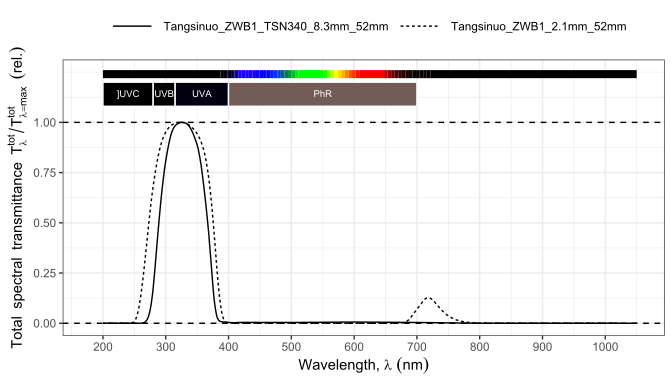
All the filters in the figures above transmit significantly in the NIR. In the case of the ZWB1 glass, transmittance is higher in the UV region than in the NIR region of the spectrum (1:0.12, Figure 4). Because attenuation increases exponentially with increasing thickness, a thicker filter discriminates better between UV and NIR. An 8-mm-thick ZWB1 filter, sold by Tangsinuo as TSN340, transmits less UV than a thinner filter but blocks NIR enough for some uses in photography Figure 8.
autoplot(filters.mspct[c("Tangsinuo_ZWB1_TSN340_8.3mm_52mm",
                         "Tangsinuo_ZWB1_2.1mm_52mm")],
         annotations = list(c("+", "boundaries"), c("-", "peaks")),
         pc.out = TRUE) +
  labs(linetype = "")

autoplot(normalize(filters.mspct[c("Tangsinuo_ZWB1_TSN340_8.3mm_52mm",
                         "Tangsinuo_ZWB1_2.1mm_52mm")]),
         annotations = list(c("+", "boundaries"), c("-", "peaks"))) +
  labs(linetype = "")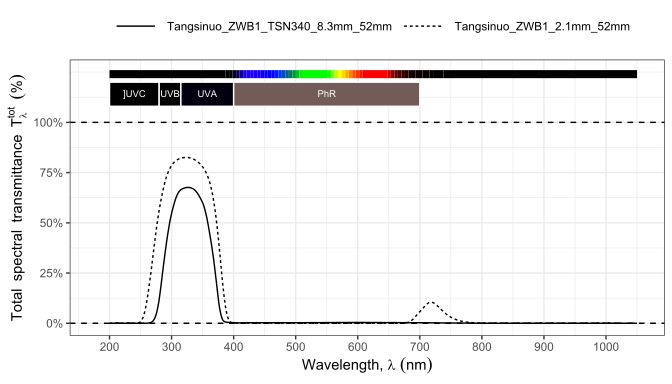
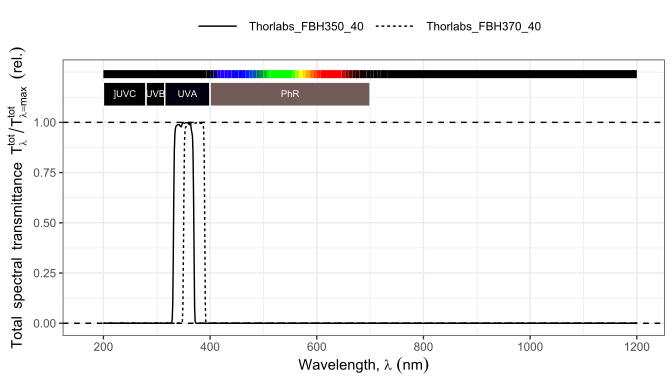
Interference filters selectively reflect light. They rely on thin layers deposited on a clear substrate. Interference filters for UV are also available. Good ones are very expensive, and more importantly their attenuation properties are dependent on the angle of incidence of the light. This makes their use for photography, specially with normal and wide-angle lenses problematic. The spectra for two of these filters, for light incident at 90 degrees to the surface, are shown below (Figure 9).
autoplot(filters.mspct[c("Thorlabs_FBH350_40", "Thorlabs_FBH370_40")],
         annotations = list(c("+", "boundaries"), c("-", "peaks")),
         pc.out = TRUE) +
  labs(linetype = "")

autoplot(normalize(filters.mspct[c("Thorlabs_FBH350_40", "Thorlabs_FBH370_40")]),
         annotations = list(c("+", "boundaries"), c("-", "peaks"))) +
  labs(linetype = "")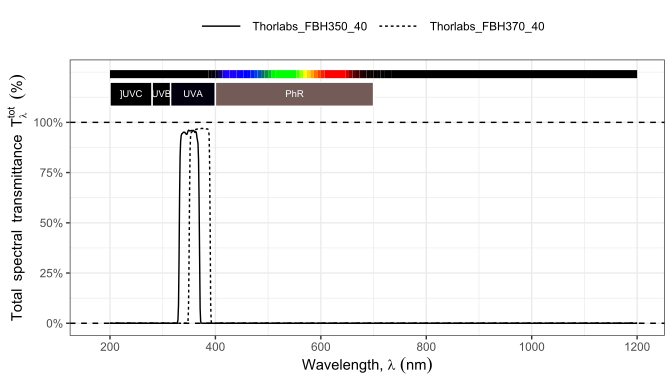
A practical and effective way of blocking the undesired off-band transmittance of filters is to combine two or more filters. Absorptive filters can be stacked as discused in the page on UV short-pass filter stacks and an interference filter can be deposited on their surface. Spectra for three different UV filters are shown below (Figure 10). The Tangsinuo Venus filter looks like the ZWB2 from Figure 3 with the NIR band blocked by the interference filter on its surface. The construction of the Baader Venus-U is similar in approach, using Schott UG11 1 mm thick in the old version that I have. The current version is likely different as the spectrum is no longer shown at their website. The one I have, even if using UG11 glass as substrate seems to have a dichroic filter that narrows the UV pass band.
astro_filters <- c("Baader_U_filter_1.0mm_48mm",
                   "UVROptics_StraightEdgeU_Mk_I_5.0mm_52mm",
                   "Tangsinuo_Venus_2mm_30.5mm")
autoplot(filters.mspct[astro_filters],
         annotations = c("-", "peaks"),
         w.band = c(UV_bands("CIE"), IR_bands("CIE"))) +
  labs(linetype = "") +
  theme(legend.position = "inside",
        legend.position.inside = c(0.63, 0.65))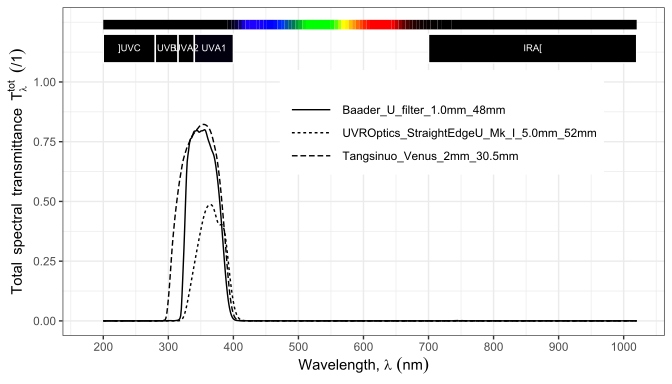
All the spectral data shown above in the figures have been measured by the author with the same Agilent/Hewlett-Packard diode array spectrophotometer (HP 8453). The typical spectra from Schott are from 2015. The data are available in R package `‘photobiologyFilters’. The figures were produced with R package ‘ggspectra’, which is an extension to package ‘ggplot2’. All these packages are open-source and available through CRAN. See also the R for photobiology web site.
Page rendered with R packages ‘photobiology’ 0.14.2,
‘ggspectra’ 0.4.0, ‘photobiologyFilters’ 0.6.1.9002, and quarto cli 1.9.37.