---
title: "NIR long-pass filters"
subtitle: "Differences in the transmission spectrum"
author: "Pedro J. Aphalo"
date: "2021-02-01"
date-modified: "2026-06-11"
toc: true
categories: [equipment, filters]
keywords: [filters, near infrared, spectra]
format:
html:
code-fold: true
code-tools: true
lightbox: auto
---
::: callout-note
I have updated this page when transferring it to Quarto. I changed the plots to be built in R within the R markdown source file. As a result the page now also includes the listing of the R code used to create all plots. More recent updates add information about filters that I have acquired after I originally wrote the
page.
:::
{{< include /_includes/folded-code-tip.qmd >}}
```{r, message=FALSE}
library(photobiology)
library(photobiologyFilters)
library(ggspectra)
library(patchwork)
library(knitr)

knitr::opts_chunk$set(
  fig.width = 7, fig.height = 4, dev = "svg", out.width = "95%", message = FALSE
)
theme_set(theme_bw() + theme(legend.position = "top"))
```
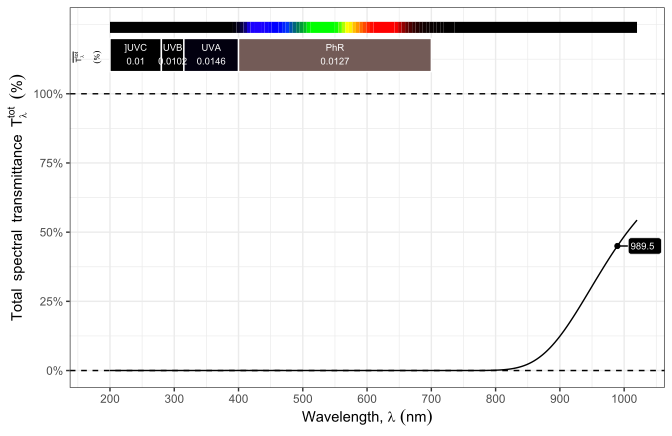
All the near-infrared (NIR) long-pass filters described in this post, except one, are absorptive glass filters and sold for special photography effects. The remaining one is an interference filter sold for use in astrophotography. All modern photography digital cameras have internal UVIR-cut filters. Use of NIR-long-pass filters requires special film, special digital cameras or modified DSLR or DML cameras. Some filters can be used with unmodified digital cameras with very long exposure times. Few normal camera objectives are designed to work well in NIR. Two problems are common: 1) focus shift which needs special attention when focusing is done in visible light (e.g., using an optical viewfinder rather than an electronic viewfinder (EVF) or live-view (LV) from the camera sensor), 2) reflections causing "hot spots", usually at the center of the images, which depend on the lens used and the aperture setting.
It is controversial how much reflections at the NIR-long-pass filters contribute to the hotspot on the photographs. Most likely, is that it depends on the situation and lens. Lately some anti-reflection coated (ARC) and multi coated (MC) NIR long-pass filters have been advertised as helping reduce the problem of hot spots (sold by [Kolari Vision](https://kolarivision.com/product/kolari-vision-pro-slim-infrared-lens-filter/)). I have not tested Kolari Vision's filters, as I do not have one of them. However, these are not the only ARC filters available. Based on their spectral transmittance and labelling other NIR-pass filters are ARC even if not always advertised. Taking into account the reflection on both surfaces of the filter, uncoated optical glass attenuates light by nearly 10% when the light beam is normal to the filter (at 90 degrees to the surface). The exact value can be computed from the difference in refractive index between air and glass, while the refractive index of the glass depends to some extent on its composition as explained in the call out.
::: callout-note
The reflection at a glass-air interface can be computed from the difference in refractive index. In filters and glass plates we need to consider two interfaces. Reflectance, the fraction of light reflected, is at its minimum when the light beam is normal (at 90 degrees) to the surface. The refractive index depends on the composition of the glass, especially in the case of glass types used for lenses.
If we consider an ordinary BK7 glass plate (n = 1.51 at 900 nm and n = 1.54 at 350 nm), and a light beam with no deviation from normal, for a single air interface reflectance varies between 4.5% in the UV-A to 4.1% in the near infrared. Or very roughly, between 8% and 9% for a plate.
```{r}
Rfr_from_n(angle_deg = 0, n = c(1.51, 1.54))
```
Anti-reflection coatings based on thin films modify the properties of the glass-air interfaces. While a single anti-reflection (AR) coating on both surfaces can decrease total reflectance to approximately 1% multi coating (MC) can reduce it to less than 0.1%. Based on this we can guess from the spectra in the figures below, which filters have been coated to reduce reflections (are AR coated) and how effective these coatings are at different wavelengths. For this we need to assume that at some wavelengths the filter glass is fully transparent (internal transmittance near the ideal 100%) and the decrease in transmittance is caused by reflections.
:::
The precision of the optical polishing and lapping and anti-reflection coating are the properties that will determine whether the filters will degrade image quality or not. Imperfections in the optical polishing are most easily visible when panning while recording video. With respect to mechanical protection the hardness and thickness of the glass and possibly also of the metal in the filter frame (brass vs. aluminium) can be relevant. The thickness of optical glass filters used in photography is usually between 1 and 3 mm, except for stacks. Some filters have an additional "nano" coating that helps repel dirt and water making them easier to maintain clean.
The most common cut-on wavelength for "IR" filters used in pictorial photography is 720 nm, so we start be comparing filters with this characteristic, at least nominally (@fig-720nm). The Haida IR720 is the only one of the NIR filters in this figure to be advertised as anti-reflection coated. It seems to use a coating optimized for visible light, very similar to that used in Hoya's 25A HMC in @fig-red-NIR. As transmittance is well above 95% for the Hoya R72 we must conclude that this filter has an AR coating, possibly a single coating optimized for NIR as the high transmittance can be observed all the way to the end of range of measurement at 1100 nm.
```{r, fig.asp=1.5}
#| label: fig-720nm
#| fig.cap: Near infrared (NIR) long-pass filters with cut-on wavelengths between 600 and 730 nm.
autoplot(filters.mspct[c("Haida_IR720_NanoPro_1.7mm_62mm",
                       "Hoya_R72_2.4mm_52mm",
                       "Zomei_IR720_2.1mm_30.5mm")],
         annotations = list(c("+", "wls.labels", "boundaries"), c("-", "peaks")),
         pc.out = TRUE,
         facets = 1L)
```
Of the filters measured, only the ones from Heliopan have brass rings. The Orange and Yellow filters from Heliopan and Hoya are multi-coated and reflect negligible amounts of visible light with a normal beam. The filters from UQG, Tangsinuo and Purshee are not AR coated (@fig-yellow-orange).
```{r, fig.asp=3}
#| label: fig-yellow-orange
#| fig.cap: Long-pass filters from Tangsinuo, Purshee, UQG, Heliopan and Hoya with cut-on wavelengths between 400 nm and 600 nm. UQG and Heliopan use Schott glass.
autoplot(filters.mspct[c("UQG_GG400_3mm",
                         "Purshee_JB450_2.1mm_30.5mm",
                         "Tangsinuo_JB450_2.0mm_52mm",
                         "Heliopan_Yellow_5_SH_PMC_2.3mm_52mm",
                         "Hoya_Y_(K2)_HMC_2.3mm_52mm",
                         "Heliopan_Orange_22_SH_PMC_2.2mm_52mm")],
         annotations = list(c("+", "wls.labels", "boundaries"), c("-", "peaks")),
         pc.out = TRUE,
         facets = 1L)
```
The RG665 from Heliopan is AR coated, possibly even MC, although not advertised as such (@fig-red-NIR). The RG695 and RG780 are not AR coated. The coatings of the Orange and Yellow filters seems to be optimized for visible light, while the Heliopan RG665 has a coating optimized for NIR.
```{r, fig.asp=2.5}
#| label: fig-red-NIR
#| fig.cap: Long-pass filters from Tangsinuo, Heliopan and Hoya with cut-on wavelengths between 600 nm and 800 nm. Heliopan use Schott glass.
autoplot(filters.mspct[c("Hoya_25A_HMC_2.3mm_52mm",
                         "Tangsinuo_HB650_2.1mm_52mm",
                         "Heliopan_RG665_2.3mm_46mm",
                         "Heliopan_RG695_2.2mm_46mm",
                         "Heliopan_RG780_2.3mm_46mm")],
         annotations = list(c("+", "wls.labels", "boundaries"), c("-", "peaks")),
         pc.out = TRUE,
         facets = 1L)
```
A collection of cheaper filters from Zomei, none of them AR coated and with rather large variation in cut-on wavelength between batches, clearly visible comparing filters of the same specification except for size (@fig-zomei-pairs).
```{r, fig.asp=0.65}
#| label: fig-zomei-pairs
#| fig.cap: NIR long-pass filters from Zomei with cut-on wavelengths between 650 and 950 nm. Pairs of filters of the same type compared.
#| fig-subcap:
#| - "Zomei IR680"
#| - "Zomei IR720"
#| - "Zomei IR760"
#| - "Zomei IR850"
#| - "Zomei IR950"
autoplot(filters.mspct[c("Zomei_IR680_2.1mm_30.5mm",
                         "Zomei_IR680_2.1mm_52mm")],
         annotations = list(c("+", "wls.labels", "boundaries"), c("-", "peaks")),
         pc.out = TRUE)

autoplot(filters.mspct[c("Zomei_IR720_2.1mm_30.5mm",
                         "Zomei_IR720_2.0mm_72mm")],
         annotations = list(c("+", "wls.labels", "boundaries"), c("-", "peaks")),
         pc.out = TRUE,)

autoplot(filters.mspct[c("Zomei_IR760_2.1mm_30.5mm",
                         "Zomei_IR760_2.0mm_52mm")],
         annotations = list(c("+", "wls.labels", "boundaries"), c("-", "peaks")),
         pc.out = TRUE)

autoplot(filters.mspct[c("Zomei_IR850_2.1mm_52mm")],
         annotations = list(c("+", "wls.labels", "boundaries"), c("-", "peaks")),
         pc.out = TRUE)

autoplot(filters.mspct[c("Zomei_IR950_TTmm_52mm")],
         wls.target = 0.45,
         annotations = list(c("+", "wls.labels", "boundaries"), c("-", "peaks")),
         pc.out = TRUE)
```
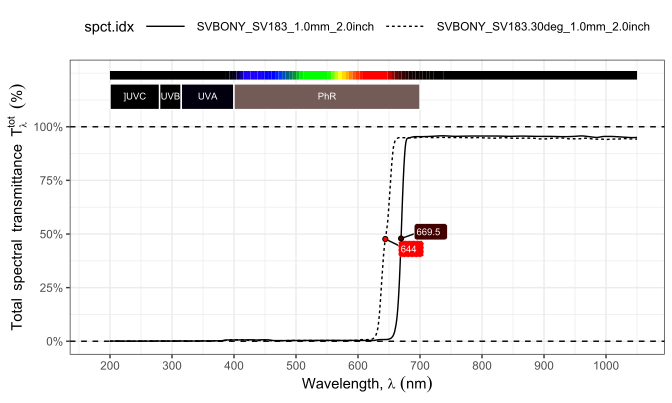
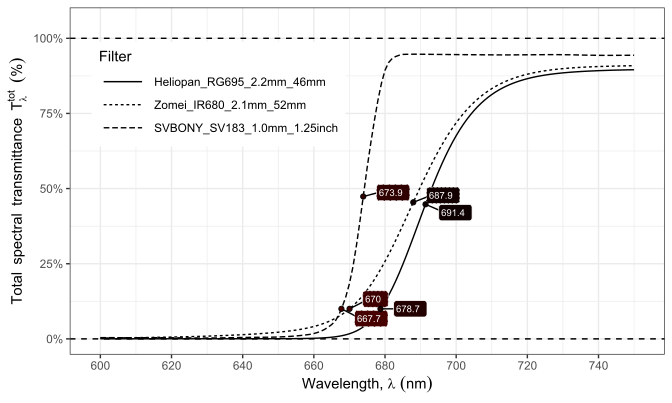
In May 2026 I acquired two SVBONY SV183 long-pass interference filters with a nominal cut-in at at 685 nm (@fig-NIR-sv183). As they reflect almost all visible light they look like mirrors. These filters are sold for use in astronomy and available only in two sizes, 1 1/4" and 2". Considering the type of filter and its high quality it is cheap at the price of 41 € I paid for the 2" version and 21 € for the 1 1/4" version. This filter type is specified at OD2 for blocking in VIS and transmittance > 95% in NIR, being AR coated. Being an interference filter it has a steeper transition between blocking and transmitting than absorptive filters (@fig-NIR-abs-dichroic). For reflected light photography there is little advantage in using an interference filter as the cut-in wavelength depends on the angle of incidence of the light making such filters unsuitable for use with wide angle lenses. However, when photographing NIR fluorescence induced by UV or blue light an interference filter is better than absorptive filters made of ionic glass: interference filters do not absorb the light they block, they reflect it. Thus while NIR long-pass ionic glass filters fluoresce in the NIR region contaminating the NIR fluorescence from the object being photographed, interference filters do not fluoresce.
```{r, fig.asp=0.6}
#| label: fig-NIR-sv183
#| fig.cap: Long-pass interference filter SV183 from SVBONY with light incident at 90 and 60 degrees to the surface.
autoplot(filters.mspct[c("SVBONY_SV183_1.0mm_2.0inch",
                         "SVBONY_SV183.30deg_1.0mm_2.0inch")],
         annotations = list(c("+", "wls.labels", "boundaries"), c("-", "peaks")),
         pc.out = TRUE)
```
```{r, fig.asp=0.6}
#| label: fig-NIR-abs-dichroic
#| fig.cap: Long-pass interference filter SV183 from SVBONY compared to absorptive filters Heliopan RG695 Zomei IR680. Heliopan uses Schott glass. This plot zooms into the wavelengths near transmission edge of the filters. wavelength axis is
autoplot(filters.mspct[c("Heliopan_RG695_2.2mm_46mm",
                         "Zomei_IR680_2.1mm_52mm",
                         "SVBONY_SV183_1.0mm_1.25inch")],
         annotations = list(c("wls.labels", "boundaries")),
         wls.target = list("half.maximum", 0.10),
         range = c(600, 750),
         idfactor = "Filter",
         pc.out = TRUE) +
  theme(legend.position = "inside",
        legend.position.inside = c(0.25, 0.75))
```
The KolariVision Gen II filters are missing from this article as I do not have any of them. According to the data provided by KolariVision, they have a very effective AR coating optimized for NIR.
::: callout-note
# NIR band-pass filters
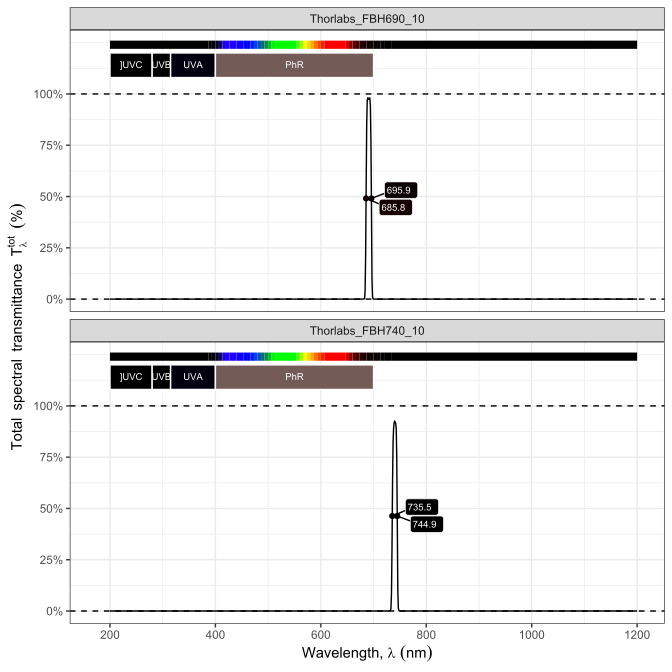
Interference filters used in research have even steeper transitions between blocking and transmitting regions. The two filters in @fig-NIR-band-pass are specified with OD5 in the blocking region, this is two orders of magnitude better than the SV183 filter above. These are guaranteed specifications, and in practice based on the measurements the SV183 is better at blocking than the guaranteed off-band OD2 off-band (T = 1%). These Thorlabs filters are expensive at about 200 € for filters 25 mm in diameter.
```{r, fig.asp=1}
#| label: fig-NIR-band-pass
#| fig.cap: Two example NIR band-pass filters from Thorlabs.
autoplot(filters.mspct[c("Thorlabs_FBH690_10",
                         "Thorlabs_FBH740_10")],
         annotations = list(c("+", "wls.labels", "boundaries"), c("-", "peaks", "summaries")),
         pc.out = TRUE,
         facets = 1)
```
:::
As for cost, taking as example the filters with cut-on near 720 nm and a size of 58 mm, the Zomei is the cheapest at less than 15 € (on never-ending sale), the Haida is at 30 €, the Hoya at 65 € and the Heliopan at 75 €, while the Kolari Vision at 85 USD, would cost over 100 € after delivery to Europe and VAT. In AliExpress one can find even cheaper filters, at around 10 €.
::: callout-tip
# Data and software availability
All the spectra shown above in figures have been measured by the author with the same Agilent/Hewlett-Packard diode array spectrophotometer (HP 8453), except for the Thorlab filters for which the data are from the online-catalogue of the manufacturer. The data are available in R package ['photobiologyFilters'](https://docs.r4photobiology.info/photobiologyFilters/). The figures were produced with R package ['ggspectra'](https://docs.r4photobiology.info/ggspectra/), which is an extension to package ['ggplot2'](https://ggplot2.tidyverse.org/). All these packages are open-source and available through [CRAN](https://cran.r-project.org/). See also the [R for photobiology web site](https://www.r4photobiology.info/).
Page rendered with R packages
'photobiology' `r packageVersion("photobiology")`,
'ggspectra' `r packageVersion("ggspectra")`,
'photobiologyFilters' `r packageVersion("photobiologyFilters")`,
and quarto cli `r quarto::quarto_version()`.
:::